Although we had to check out today at 12, we wanted to use the motorbike once more to finally reach the temples we wanted to see the day before (but were not able to since we had to return earlier to get our new credit card). So we got up early and left to the north of Ubud. After about 1 hour and many small shortcuts through the villages instead along the heavily used main road we arrived at the Pura Tirta Empul, one of the holiest Hindu temples in Bali and still widely used for water ceremonies since it is located at the holy spring of the Pakrisan. Built in the 10th century it is still used by many worshipers from all over Bali. So it was also not surprising to see many prays and ceremonies (with and without the holy water) going on during our short visit.

 Like most holy springs, the basins containing holy water are home of hundreds of large fish.
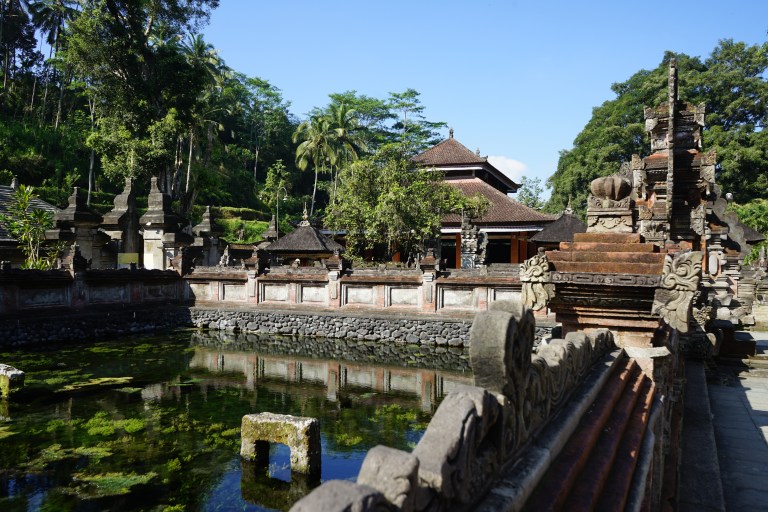 This planted pond was of special interest as it seemed that it contains parts of the spring itself. But unlike the water used directly for the ceremonies, which is guided through pipes to enter the basin through the walls (we have shown some of these inlets in a previous post), it was pushing through the mud on the ground, creating standing but never stopping underwater clouds of dirt.
With the time running we decided to just quickly look at an additional temple very close to us which was proposed to us by Steffi: Pura Gunung Kawi (this time without Sebatu at the end). Unfortunately it was very tricky to find the way from where we were right now, so we asked some local guys how to get there. They guided us to a small village (this part of the path was also shown on google maps). There we had to stop our motorbike, although we did not see any temple entrance or parking nearby and started walking along a narrow road. We entered a forest leading to some rice fields where many people were working on with our new guide (a young man in our age) helping us as much as possible through the rough terrain.
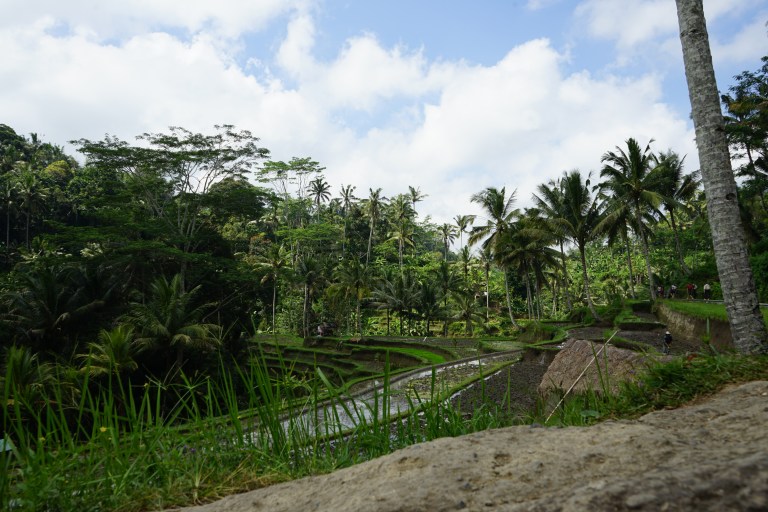 After crossing the rice fields we were able to see the temple downhills in a valley. So the next part was to climb down some small and slippery routes for about 20 minutes until we finally reached the temple, which we entered at the back after crossing a waterfall.
The temple itself was beautiful and very large with 10 huge monuments (about 7 meters high) carved into stonewalls. The monuments are part of a large burial site with some of them named after queens. The statues are facing each other separated by a river cutting the area in halves.
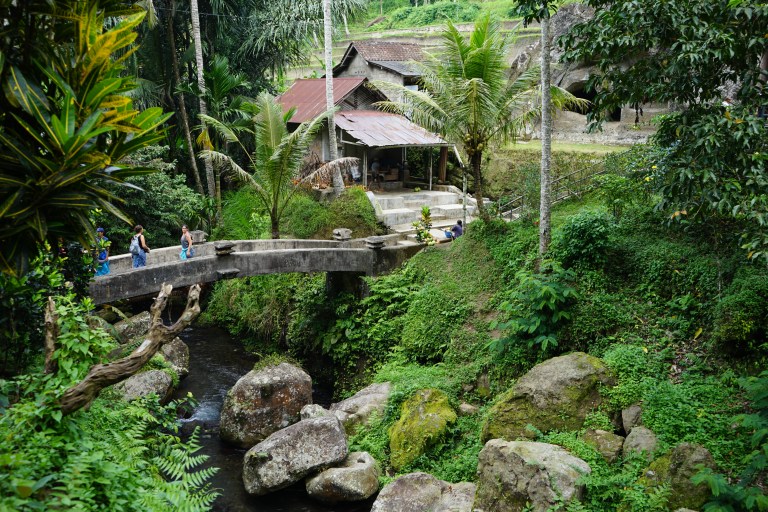 A small bridge connecting the two sides of the temple.
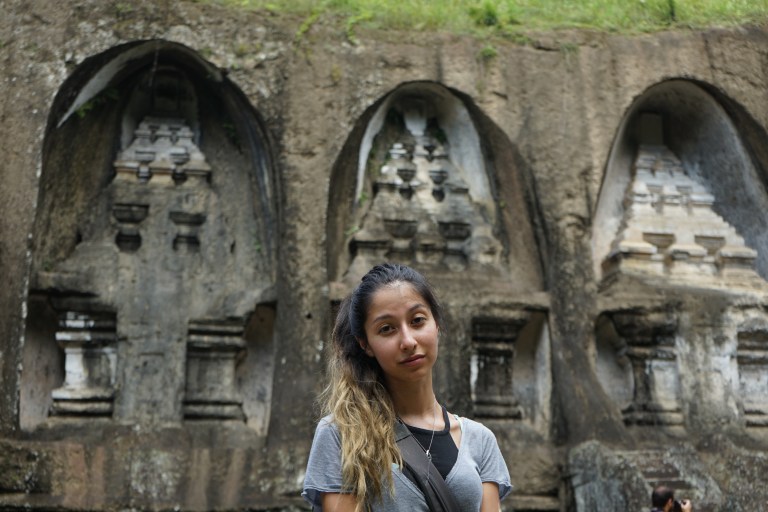 The left side of the temple with some of the monuments, facing the once on the right side which are shown in the title image.
Since we entered the temple on the back (important to mention: of course we did wear a sarong. Our local guide had one with him for Nino while Svenja always had one in her backpack.) we had to climb up the endless stairs built into the stone to reach the entrance and to get our ticket like every other tourist does. When we reached the entrance (never try to get there at noon, it is very steep and the sun is burning directly onto you) it was about 11:50 am and we had 10 minutes left to check out. So we headed back down the stairs and had to climb up through the forest and the rice fields once more after passing an additional waterfall to get back to our motorbike.
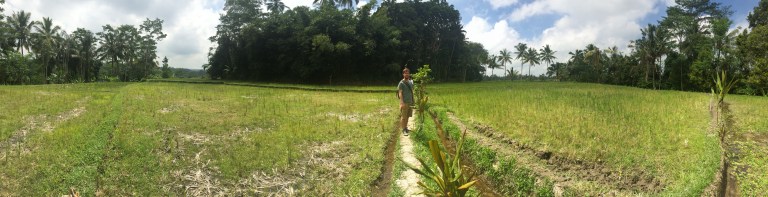 On our way up we quickly took our time to at least send an email to our reception and to inform them about our delay. Although very exhausted and with all the locals asking us if we do not want to take a quick break and drink something (seems like this path is very exhausting even for them) we got onto the bike and started of taking the shortest path back to Ubud.
With only driving in circle once we reached our hotel with a delay of about 80 minutes, which to our surprise was no big deal for them. Our next stay was in Ubud too, or at least we thought that. The driver from the old hotel moved us to the new one where they welcomed us and informed us, that they do not know anything about our arrival nor about our reservation.
The hotel was a gift to Svenja by her godmother and so we did not do the booking by ourselves. It turned out that, since we were talking with her about Indonesia a lot, we were confused and the hotel she wanted to invite us was in a totally different part of Bali. Unfortunately it took us much longer to figure that out since the owner of the Ubud Hotel, a guy acting as if he’s his own biggest fan, did not allow us to quickly check our emails with the reservation confirmation but rather wanted to distinguish himself.
After we were finally able to resolve the problem and found a taxi (of course without taxameter, as he almost threateningly screamed into our faces that they get beaten up in this region for picking up people. Although he wasn’t even able to answer us how a tourist should be able to know what a fair price for a drive would be (we once payed 200’000 for one way and only 70’000 for returning))… Lets restart the sentence: After we were finally able to resolve the problem and found a taxi, we drove to Canggu in the south-east of Bali to the beautiful Desa Seni Village Resort, a small village built like a typical village in Indonesia with a lot of agriculture (80% of the food served is made by themselves) and famous for its yoga-classes.
 A typical cottage as ours at the Desa Seni, everything surrounded by large big trees and many fields with different vegetables.
 Adventure Time